


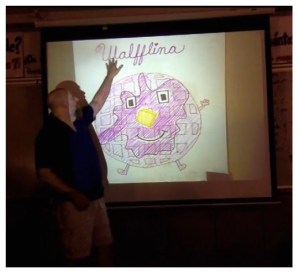


Wafflina is a character that one of my students created when we had a few minutes the day before Thanksgiving break. She is a pink waffle that lives in IHOP and laughs at all of the pancakes that get eaten there. She does not realize that humans eat waffles too.
Before the class period I was flipping through my pile of characters and I found this picture. One of my students had written a description of her Invisibles character on the back of the paper. I started the class with the picture projected against the board and I supplied a few details that came from my student´s imagination. There is something about a student-generated illustration that immediately draws other students into the drama of the class. Teaching with Ben Slavic´s Invisibles method, we use student drawn characters to co-create little vignettes in class. When I have a pre-planned TPRS story I am usually exhausted at the end of a school day, but after a day of Invisibles I feel invigorated and ready to go live my life at the end of the school day. As you will see in the video, I am not working terribly hard at moving the story forward. The kids do most of the work… I just keep it comprehensible and in Spanish.
Prior to the video we spent 5 minutes on FVR (these level 1 students are just starting independent reading). At the end of the video, after writing up our story on the board, I had students turn their backs towards the board and I asked them comprehension questions. However in the action of turning their chairs around about a half dozen students placed their chairs within sight of the camera, so I had to delete that last section. You will hear me frequently consulting with the time keeper, a student who moves our stories along so that they are completed within one class period. In this class we agreed to spend 5 minutes per section. I have a poster with the four sections of the story on my back wall. In the first section we determine Who? Where? and With whom?, in the second section we flesh out the problem that the characters face, in the third section there is an attempt to solve the problem but that attempt fails, and in the last 5 minutes of the story there is a successful resolution to the story.
The next day we used a variety of activities to reprocess the story. Jillane Baros, a gifted teacher who posts often on the facebook CI-Lift Off page, recently shared a quick list of CI activities to process a reading, which you can download here. I use Textivate a lot… often rather than writing on the board I will write directly into Textivate so that it saves our class stories for the future. Every 2-3 weeks my students create a quick write on their own using phrases that they have acquired from these class stories, but creating their own narratives. Through these quick writes I observe the natural development of their second language. Check out the CI-Liftoff facebook page or the videos posted on youtube to see other teachers adapting this method to their own classroom.

