


We have very little time with our students. Over the course of a four year program we typically have anywhere from 450 to 600 class hours, while research suggests that it takes thousands of hours to acquire a second language. Students may expect to leave our programs “fluent”, but most language teachers understand that we are truly aiming to develop enough language so that students can continue the process on their own.
As opposed to past years, this year I have followed a mostly non-targeted approach. Before taking this step my main concern was whether a non-targeted approach would provide enough repetitions of core, high-frequency language so that students would thoroughly acquire the language rather than just remain in a perpetually confused state of “I-kind-of-sort-of-understand”. I knew that, given enough exposure to interesting & comprehensible language, they would acquire it eventually. My question: is there enough time in a school day so that eventually comes quick enough? Or is a tightly targeted curriculum better suited for the reality of preparing students to fly on their own someday.
First of all a caveat: I did target the super seven verbs and then the sweet sixteen verbs during the first few hours of instruction. In the past I would have methodically worked on the third person present tense forms, followed by second person and first person forms so that, by late October, I would be introducing past tense forms while casually using other tenses as needed (subjunctive, future, conditional, perfect tenses). This year the targeting was limited to the 3rd person of the sweet 16 verbs, which was complete by early September.
I have written before about how TPRS is a humane, inclusive method which allows students to blossom at their own natural pace. The non-targeted lessons based on One Word Images and Ben Slavic´s approach to story-asking (which he calls the Invisibles) also move as slowly as my best targeted lessons. Nobody is getting left behind; everything is as comprehensible as before. I think the interest level is higher because the personalization of the Invisibles story is deeply embedded into the DNA of the activity, whereas my targeted stories are about as personalized as a Mad Lib activity. Kind-of personalized, but the kids see right through it.
My biggest surprise with the non-targeted approach is the realization that I have more opportunities to differentiate for fast processors while not losing the slower processors. In the past I would spend time trying to find student jobs and other ways of occupying the busy minds of my fast processing students. Part of their classroom experience was learning to remain focused and to not blurt out before the rest of the students had the opportunity to process the language. This year I am reaching the high-fliers in class like never before with variations of Beniko Mason´s story listening technique.
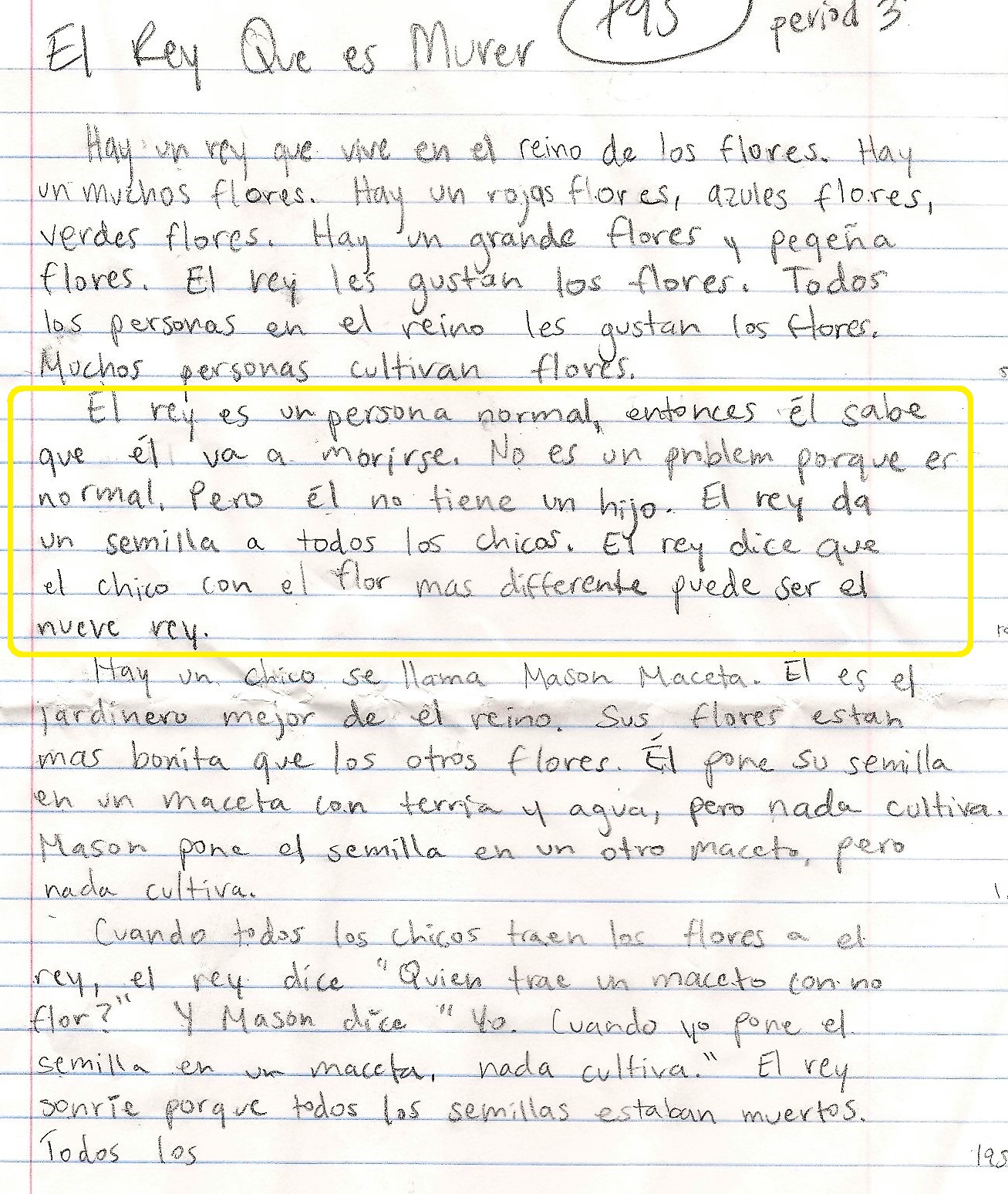
Below are the quick writes produced by a few outstanding Spanish 1 non-heritage learners. These are just beautiful and demonstrate a richness of language that I would not expect, and certainly would not have targeted, for students in their fifth month of language classes. Some of the words I expect will drop out of their active vocabulary (maceta, semilla). But some of the expressions are not actually coming from this specific story. It is pretty darn cool. It is no longer a question of whether I have time to differentiate for fast processors; I have found non-targeted story listening to be a surprisingly efficient addition to my repertoire.
Here is a link to a video of the story listening activity that I told. I think I was very low-energy that day… which is a good sign that this technique works!


