


Last week, the best conversation in my class emerged from a student interview. The question (posed in Spanish):
Is there something in your refrigerator that nobody wants to eat?
There is only one word, refrigerator, that might trip up my students. The problem isn’t vocabulary.
The tricky part is the imagination work—getting students to imagine answers before reflexively answering no.
So I pose the question in Spanish, write it on the board in both languages, and then tell them about the tupperware of soup that has been sitting in the back of my fridge for months. Am I the only one? I ask them.
Nobody wants to appear like a slob, but when I say “Am I the only one?”, someone in the class feels the need to assure me that no, I am not the only one. And then the floodgates open. Students want to share the disgusting things in their refrigerators. It’s hilarious. They are mostly shouting out in English while I am at the board, writing ideas quickly in both English and Spanish.
In Zahana’s fridge, it turns out, there’s a container of chicken necks with rice. I have seen chicken necks offered in restaurants in Tijuana, so I could not resist a side conversation in English about how her family makes their chicken necks. Totally different recipe!

But, you might ask, why let them scream out in English in a Spanish class?
The transition from brainstorming to Write and Discuss is crucial.
When we are brainstorming, I write in both languages and “think aloud” in Spanish. When I cross the room to the other white board, we start the Write & Discuss activity now processing in Spanish.
I start writing on the board “En el refri del señor Peto”. Then I pause and ask, “¿Qué hay en el refri del señor Peto? ¿Hay lasaña?” The class responds quickly: “sopa de tomate”
I say: “Sí, en el refri del señor Peto hay un tóper con sopa de tomate. Pero, ¿cómo es la sopa? ¿Todavía está… is it still… todavía está buena la sopa?”
They respond: “No, es verde.”

We continue this conversation, now entirely in Spanish, and I embellish their responses to bring the written language a step up from our spoken exchange.
“¿Quién quiere comer mi sopa vieja?”, I ask the students. “¿Tú?”, I ask one student. “No, NADIE quiere comerla. What does nadie mean?”
“Nobody”, they all respond.
And here is where I bring the conversation a step up:
“Nadie quiere comer…”, I look at my transition word magnets and pull off the word “así”.
“Nadie quiere comer algo… (I write the word something under algo), something like that.” I place the ASÍ magnet at the end of the sentence.
And then one more time: “Nadie quiere comer algo así, una sopa vieja y verde. Qué asco.”
Altogether we spent 15-20 minutes of class time on this, and then moved on. We don’t drill the vocabulary, and rarely do we even return to the texts we make. On this particular day we followed our interview question with a movie talk, and then we ended class with an unannounced writing assessment.
The writing prompt at the end of class took us back to yesterday’s story. What I look for in these samples is what students can do when they have something to say and I’m no longer at the board to help them say it. Here is what a level 1 student wrote:

She is a level one student making level 1 errors (gender, ser & estar, conjugations).
But her writing is also entirely comprehensible.
I’m pretty happy that she forgot how to say “love potion” and replaced it with “agua de amor”, or love water. That is level 1 genius.
Here is another writing sample by a level 1 student.
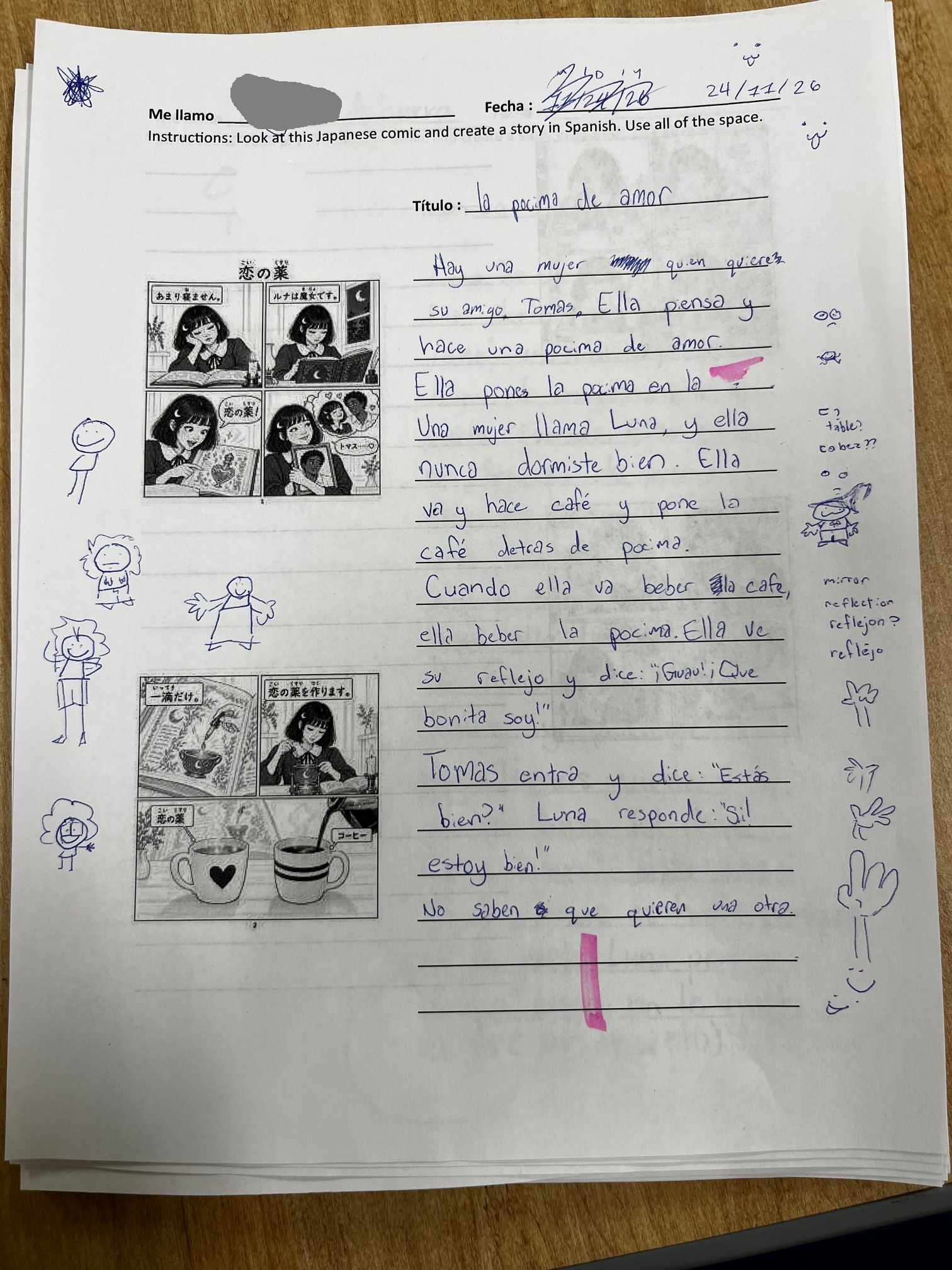
There are wonderful moments in his writing that flow naturally. I can see that he is listening to me in class. When I read “Ella nunca dormiste bien,” I can hear my own morning question: “¿Dormiste bien?” He’s telling me that she never slept well, and I understand him. The dormiste sounds so familiar I can practically hear myself taking attendance.
I am not at all concerned that a level 1 student cannot precisely control the grammar.
I can’t predict which part of a conversation a student will carry into tomorrow. So when a question gets us fifteen good minutes, I’m happy to write up what we said and move on. Nobody has to remember how to say chicken necks. But for a few minutes, everybody wanted to know what was in Zahana’s fridge, and we got to tell that story together in Spanish.