


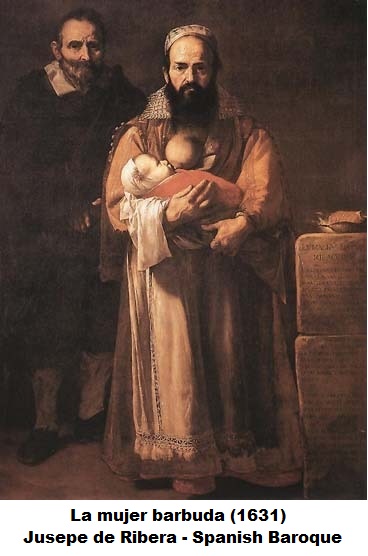

The reading that is attached at the end of this post grew out of a class joke, which itself grew from a class story based loosely upon on a real student in class and his attempts to win over his strict history teacher. In our class story, and this reveals how a teenager’s mind works, our student decided to win the heart of his strict history teacher by dating her sobrina. Given that the teacher is Cuban we decided that her sobrina must be named Fidelita and have a large beard, just like her namesake. Today, before giving the reading that follows as homework, I am going to present Jusepe de Ribera’s painting La mujer barbuda which is certainly one of the oddities of Spanish baroque. One of the interesting things about this painting is that the artist treats the subject with dignity, inviting the viewers empathy rather than the mockery that I would expect of a painting about a “freak”. You can read more about the painting by following this link. If you’d rather see a video in Spanish, RTVE used to have an excellent series called Mirar un cuadro, each episode dedicated to one work of art. In the episode dedicated to La mujer barbuda you watch a very brief explanation by an expert, followed by about ten minutes of commentary from a group of adolescents who appear to have been students in an art history class. The Spanish spoken is beautiful… I’d love to figure out how to present this to my AP class but the language is a bit over their heads. Click here for the link.
This reading really has nothing to do with Jusepe de Ribera, except for the appearance of bearded women. It departs from the perspective of my student’s real life girlfriend and the problems that he has supposedly encountered due to all of the chisme surrounding his efforts to do well in history. Structures being recycled in the reading include “no le hace caso“, “las mentiras“, “descubrir“, and “acercarse“. The main target structure is “está harto de” (which is on my master list of structures I must teach this year), while inevitable new words that help the story are “chismosa” and “la mujer barbuda“. You’ll also notice that I am highlighting use of subjunctive with the verb querer. You can download the written story by clicking here (it is in .docx format so that you can change it for your own classes). It also includes several comprehension questions and three short writing prompts.